
10 Min Read • From Beirut
Agriculture at war in the South of Lebanon
As bombings continue in the South of Lebanon, agricultural production is taking a toll, with a long list of implications.
By Anna Illing
October 27, 2026
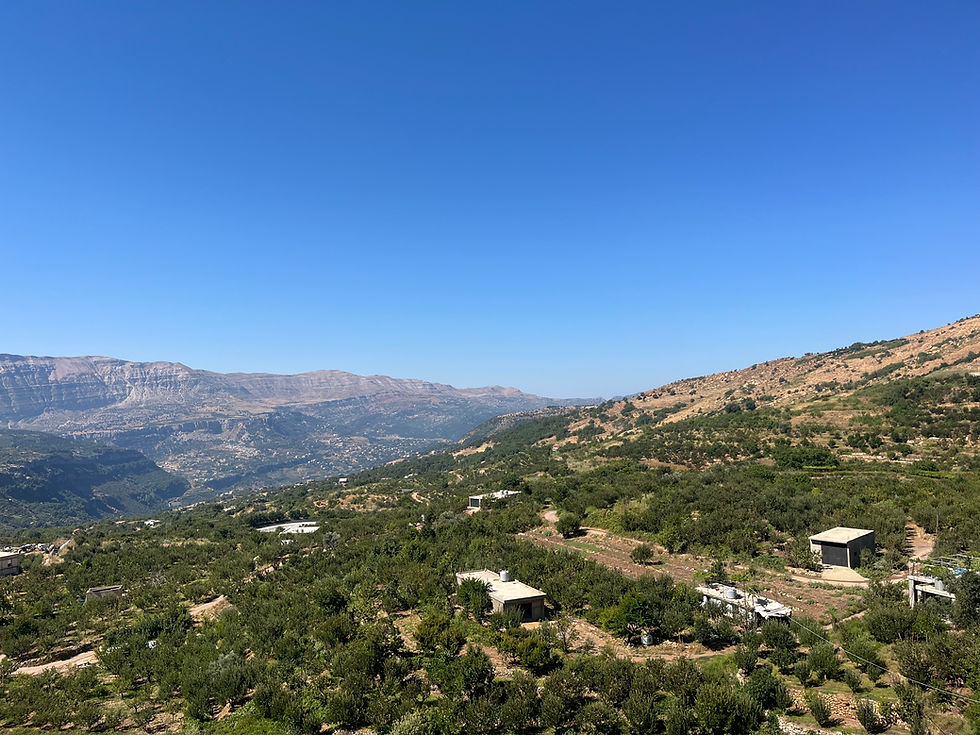
For two years, one constant for the South of Lebanon has been war, which continues intermittently since the Israeli walkie-talkie attack on September 17th, 2024.
In two years, over 22,5% of the agricultural land was hit by the war. 78% of the farmers of the South have paused its activity. Between April and August 2026, it is estimated that some 1,24 million people would be classified as experiencing extreme food insecurity. These are the data presented by the representative of the Ministry of Agriculture Louis Lahoud at the 181st session of the FAO held in Rome in June 2026.
The cycle of conflict of the last years has both repeatedly caused damage to the agricultural land and decreased long-term productivity.
The economy of short-term destruction
“War causes the burning and destruction of agricultural land and the displacement of people, with the probability that they will not be able to return”, explains Mohamad Ghassan Abiad, professor and director of the Laboratories for the Environment, Agriculture, and Food (LEAF) at the American University of Beirut (AUB). “Before this last conflict started [March 2nd, 2022, ed.] we had estimated that 63% of the farmers of the South were unable to reach their land and that around 25% of them had lost their ability to harvest and, consequently, their livelihood. Today, with what's going on, these numbers are undoubtedly higher”, professor Abiad continues.
According to an evaluation by the United Nations Development Programme (UNDP), more than 12.000 hectares of agricultural land in the region have been abandoned because of the security situation and at least 2.193 hectares were damaged by the fires caused by bombardaments are incendiary arms.
Infrastructure—such as greenhouses, irrigation systems, roads, and power lines—is also being destroyed, as Hisham Younes, founder and president of GreenSoutheners, an NGO focused on the preservation of biodiversity since 2013, points out.
The economic repercussions are significant, as in Lebanon agriculture contributes to around 9% of the GDP and employs around 4% of the labour force. In the rural areas, and particularly in the South, 80% of the local economic activity is tied to agriculture.
“Every time conflict escalates between Lebanon and Israel, a lot of the border crossings are closed or are not easily open or accessible to trucks to take produce out. So, farmers can't sell their products, and have to throw them away”, says Ghassan al Salman - Field Officer for the Environment and Sustainable Development Unit at AUB and SOLIS, an association that promotes the sharing of sustainable agricultural practices. Moreover, he adds, the uncertainty about the future disencourages investments.
In addition, the displacement of the population has meant that farmers do not have access to their lands, which has resulted in a decrease in agricultural activity. “If farmers can’t work on their land, they can’t irrigate, they can’t fight parasites, they can’t harvest. Because of all of this, we have lost six harvest seasons”, Hisham Younes specifies.
Losing a harvest season also brings up the unemployment rate: “there are many seasonal workers who are not working and without these jobs they can't feed their families”, Salem Darwich, former advisor to the minister of agriculture and professor at the Lebanese University, points out.
Al Salman notes that this situation exacerbates a generational trend that characterizes agriculture: “the younger generations are not interested in agriculture. Losing a generation means failing to pass on the knowledge, experience, skills accumulated over decades”.
Darwich identifies two reasons as to why it will take time before the situation improves. First of all, the time plants need to grow: “an olive tree planted today will start producing fruits in 5,6,7,8 years”. Second, a simple question of priority, due to the selective nature of the economic aid that can reach farmers: “I believe that if we were to give someone two options, to rebuild their house or to rebuild their agriculture activity, anyone would choose the house”. In this sense, “everything depends on the support we will receive from the international donors”, he affirms. But, due to the economic hardships that Europe and the Gulf States have experienced in the last years and, more recently, due to the closure of the Strait of Hormuz, Darwich is certain that “agriculture will be less important”.
A tired and contaminated soil
To the more immediate losses follow the long-term agricultural damages. The presence of hazardous residues—unexploded ordnance, contamination risks from the use of white phosphorus and other incendiary materials, and heavy metals—can hinder efforts to return to normal production levels. Phosphorus has a peculiar status in international law. It is not directly and explicitly banned as a chemical weapon, but as an incendiary weapon, the use of which in accordance with international legislation depends on the way and the context in which it is used. In particular, it is necessary to assess whether its use would result in foreseeable harm to the civilian population or the environment.
The fires by white phosphorus “can destroy the organic material and organism in the soil”, explains Hisham Younes. Nonetheless “phosphorus is not the concern”, says Rami Zurayk, professor of Landscape Design and Ecosystem Management Department and founding member of the Arab Food Sovereignty Network. “Phosphorus is a nutrient for plants, which is absorbed by the soil. The problem is that it burns, but it is not as dangerous as it is being portrayed”, he elaborates. Professor Abiad confirms this view: “Phosphorus burns and its smoke causes suffocation and respiratory problems among the local population. But in the long term, that’s not the main concern. Phosphorus remains in the soil for between 0 and 5 years.”
On the contrary, heavy metals, which can remain in the soil for over 50 years, are worrisome. “From the more than 500 soil samples collected from the south we have been able to confirm the presence of numerous heavy metals including lead and barium, both cancerogenous”, Professor Abiad says. He further explains that as these elements can be absorbed by plants, they can end up in the human food chain. Professor Zurayk believes, however, that Lebanon is a more favourable situation than commonly thought: “lead’s ability to dissolve in water is dependent on the soil’s pH. At pH ranging from neutral to high, as is the case for Lebanon, it has a harder time doing so”.
Professor Zurayk portrays a more optimistic picture because “the Israeli have mainly destroyed and damaged towns and cities. In the open areas, the situation is relatively good”.
In the same samples, professor Abiad detected the presence of toxic and explosive compounds such as tritolo (TNT), ciclonite (RDX), and ottogene (HMX). “Because of their toxicity, worms and microbes, who contribute to the soil’s fertility and its ventilation, do not reproduce anymore”. In their case, Professor Abiad estimates that they will remain in the soil for at least 100 years.
In this already complex context, Professor Abiad identifies another paradox, almost ironic. “Many had transitioned to an electric solar system. For this reason, in some areas, we find lead and lithium coming from the batteries of these mechanisms. These due elements were meant to represent one of the most environmentally-friendly solutions. Now, they have become one of the problems.”
Another important point related to soil’s composition. Its structure is composed of different layers, placed in a set order, each with its set role. “First you find the surface layer, then the subsoil, and beneath that, the original material,” explains Professor Abiad. Plants draw fertilizers and nutrients from the topsoil, but “the bombing have altered the physical structure of the soil and the organic matter is no longer found on the surface. It has been moved elsewhere and mixed with the various substrates,” he continues.
Conducting research in this context becomes even more complicated. On the one side, the deeper into the ground a heavy metal sets, the harder it is to detect its presence and take action, the higher the probability that underground water basins will be contaminated, Al Salman explains. From these bodies of water, heavy metals can then contaminate other plants and the food derived from them that ends up on people’s tables.
Al Salman has started to study the results of bioremediation strategies, actions to remediate the soil based on relying on natural elements, such as fungi and bacterias. “Depending on the type of contamination detected, we have to evaluate which the best combination of natural elements is to efficiently absorb hazardous substances”. he clarifies. Here is the other side of the issue: figuring out which ingredients should be included in this recipe taking into account all the different heavy metals which have been mixed into all the various layers of the soil “is a big mess”, he affirms. Scientific literature often focuses on one single plant contaminated by one single heavy metal, “but if, instead, you are faced with ten different heavy metals, varying levels of humidity and different temperatures - what do you do?”, he asks.
The combination of all these effects deplete the soil, as Hisham Younes defines it, or contribute to its depletion: “we are talking about fields that have been exposed to fires, white phosphorus, different heavy metals and glyphosate for a long time”. Which, in turn, complicates the soil’s positive response as well as its recovery.
The value of a piece of land
The land devastation is not a war objective in itself, but “breaking the tie between the population and the land” is, says Hisham Younes. “I believe that is what Israel is aiming for”, he continues. Professor Zurayk agrees. “Agriculture is also a social activity”, he reflects. From this, he argues, one cannot consider the impact of war only in terms of money or contribution to the GDP, because this social aspect is linked to a country’s “ability to resist”. “In a war context, the land can only be defended by those who have a sense of belonging, by those who live in those areas, for whom the land and its cultivation are not merely an economic activity”, he elaborates.
On a piece of paper he tries to make some calculations to explain his point, starting from the value of the 500 km², or 500 million m², of Lebanese territory occupied by Israel. “Assuming a price per m² of 50 dollars, the economic loss amounts to 25 billion dollars. Meanwhile, the land productivity is measured in the tenth of a million”. Professor Zurayk estimates that the yield from cultivating one hectare of land is around $1,000 per hectare. “500 km² corresponds to 50.00 hectares. So, if all the land was planted, the value would rise to 50 millions. As mentioned, this amounts to tenths of a million compared to the 25 billion it would cost if the territory were completely lost”.
This economic calculation is what, in the eyes of the professor, shows that what Israel is trying to do is “destroying the bond between the people and the land.” In other words Hisham Younes reaches the same conclusion: “the more [the Israeli armed forces] succeed in keeping people away from their land, the more their connection to it, the affection they feel for it, will be severed. The logic, in short, is ‘as long as we keep them away, they won’t come back’”.
Professor Abiad brings forward a comparison with the events that led to the demarcation of the border that to this day divided the island of Cyprus in two. “[In Cyprus] they have eradicated the resistance and created a so-called yellow line to then destroy all that existed in the border zone. Still today, the inhabitants call it the ‘ghost zone’. And the same is happening in the South of Lebanon”.
From his part, Al Salman raises a critique to the Lebanese government, from which he and his team have not received sufficient resources to continue their research on bioremediation. According to him, this is not a coincidence: “if you conduct research, then you find out who to blame, you find out that there are toxic substances in land areas where there is no trace of Hezbollah”.
A future far, far away
Salem Darwich explains that when he worked at the ministry, the government had begun conducting assessments of farmers’ various needs in order to support them with subsidies. In the meantime, however, the situation has changed significantly: “in 2024, the displaced population could go back, they still found a foundation from which to start their lives again. Today, with villages being completely destroyed to the ground, what type of reconstruction assessment can we even begin to make?” he asks.
For Younes, reconstruction is not only a matter of understanding how to replant trees, but rather it starts with the soil: “the habitat degradation also causes biodiversity loss. This is one of the key points that are often not mentioned in official reports”.
To have the land recover from years of war one needs “the soil, plant and animal species, and the delicate balance between them”, Younes lists. “The difficult part to face is the connectivity that characterises nature”. For this reason, he says, reconstruction is possible, but “returning to the baseline environmental conditions would be very difficult, and it is no easy task”.
With the tools available at the moment, Al Salman and his team are focusing on damage reduction. The pilot zone for their research, however, cannot be established in the South, because without a cessation of the bombings it becomes practically pointless to implement bioremediation strategies. “If we were to begin our work today to try to figure out how efficient some plant might be, and then the test area were to be bombed, the experiment would be back at square one”.
Professor Abiad highlights the issue of time: “the more we wait, the more persistent and intense the impact will be”. Al Salman agrees. SAccording to him, the more time passes by, the more the contamination level rises, the less accurate the diagnosis can be. “The problem is that the contaminating elements can move. When you return after one or two years, you may find that some contaminants have been broken down in the soil, whereas others may have simply moved to other plants and areas, which you then need to identify and test, starting the process all over again”, he explains.
And even if the war were to end tomorrow, some of the land must already be considered lost due to the high level of soil contamination. As for the land that can be reclaimed, he believes the list of actions to be taken should be based on the data: “to resonate the soil, it is necessary to first collect samples and make sure to treat it according to its actual needs. This will then ensure that it is safe to proceed with the reconstruction”.
To quote a metaphor used by Salem Darwich: “It takes very little to blow up a building, but it takes at least several months to rebuild it”.
This article was originally published in Italian for Generazione Magazine.